In a city where ambition meets opportunity, few entrepreneurs embody


In a city where ambition meets opportunity, few entrepreneurs embody

In a world increasingly seeking balance between modern science and

Prominent UAE businessman Khalaf Al Habtoor has reaffirmed his long-standing

Jami McGuairtSalazar, the Texasborn beauty who Dubai Magazine readers already



Diabetes continues to pose one of the most pressing public health challenges globally, with the Middle East facing some of the highest prevalence rates. According to the 2024 International Diabetes Federation (IDF) report, 589 million adults worldwide are living with diabetes, of which 43% remain undiagnosed. In the MENA region, 85 million adults are affected, a figure projected to rise by 92% to 163 million by 2050. Within the UAE, diabetes prevalence among adults (20–79 years) stands at 20.7%, placing the nation among the highest globally. With lifestyle-related risk factors increasing and healthcare systems facing mounting long-term burdens, early detection and prevention have become central to national health priorities.
The Case for Non-Invasive, Scalable Risk Screening
Diabetes is not merely a metabolic disorder; it is a systemic disease that drives complications such as coronary heart disease, stroke, neuropathy, and kidney failure. Early identification of risk is critical to mitigating these outcomes. Traditional diagnostic methods like HbA1c testing, however, are often inaccessible for asymptomatic populations, highlighting the need for non-invasive, scalable risk-assessment tools. Digital biomarkers now offer a bridge, allowing individuals to gain early awareness and seek confirmatory testing while reducing strain on healthcare systems.
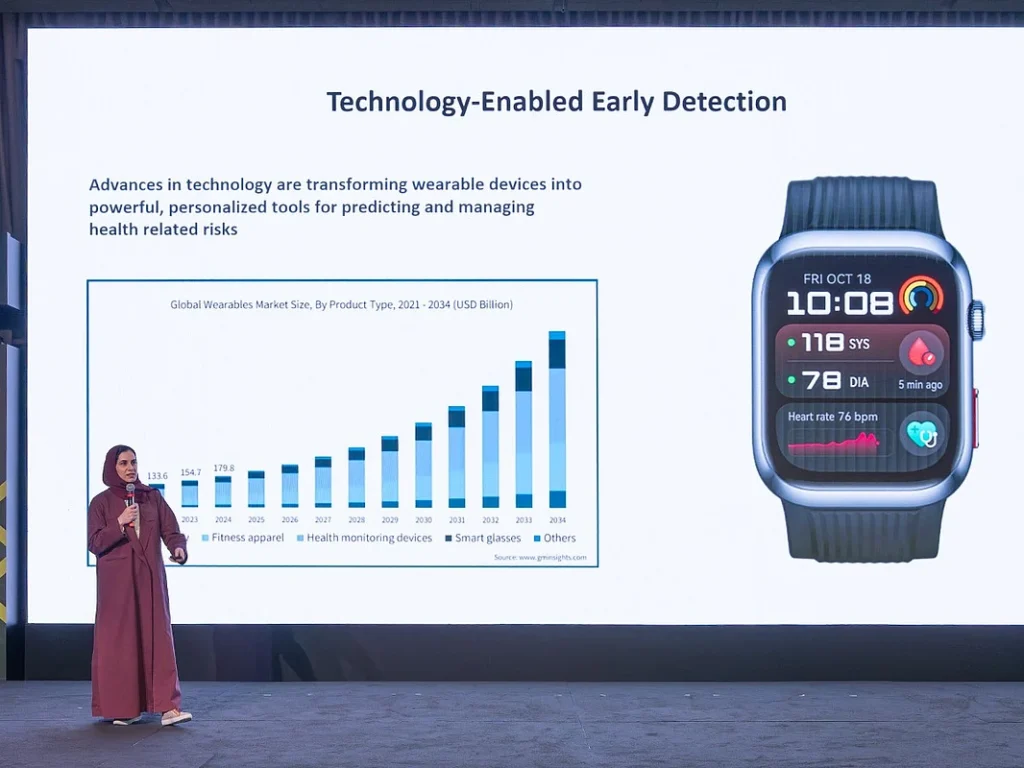
PPG Technology: From Vital Signs to Diabetes Insights
Huawei’s approach leverages photoplethysmography (PPG), a non-invasive optical method that measures blood-flow changes through the skin. By capturing reflected light from vascular tissue at the wrist, PPG can monitor cardiovascular signals, including heart rate and blood oxygen saturation. Recent studies show that diabetes affects vascular endothelial function, autonomic regulation, and microcirculation, all of which influence PPG waveforms. Moreover, shared genetic pathways between resting heart rate and diabetes further underscore the physiological connection between cardiovascular health and metabolic risk.
Advances in smartwatch sensors now allow for continuous real-world monitoring, making population-scale, passive health assessments possible.
How Huawei’s Diabetes Risk Feature Works
Integrated into Huawei smartwatches, the diabetes risk feature uses advanced PPG sensors and algorithmic analysis. Users wear the device consistently for three to fourteen days, after which the “Diabetes Risk” app provides a simple outcome: “low risk,” “medium risk,” or “high risk.” Individuals flagged as medium or high risk are advised to consult medical professionals for confirmatory testing.
Importantly, Huawei positions this tool as a preclinical risk-awareness solution, not a medical diagnostic device. The feature’s objectives are clear:
Measurements are provided for reference only, guiding users toward potential risk identification rather than formal diagnosis.

Scientific Validation and Expert Collaboration
At the World Health Expo Dubai 2026, Professor Jiguang Wang, Director of the Shanghai Institute of Hypertension, highlighted emerging evidence supporting wearable-based PPG as a reliable early risk-assessment method. Professor Wang has worked closely with Huawei on the development of the HUAWEI WATCH D and WATCH D2, devices designed for ambulatory blood pressure monitoring. Huawei’s broader health research spans facilities in Dongguan, China, and Helsinki, Finland, where multidisciplinary teams study cardiovascular health, exercise physiology, and long-term population health monitoring.
Expanding to UAE and Global Markets
Historically, Huawei’s advanced health features were first introduced in China before global rollout. The company is now prioritizing synchronized launches with collaborations involving local medical institutions, ensuring regions like the UAE access innovative health technology promptly. This aligns with the UAE’s national focus on preventive healthcare, digital health transformation, and early disease intervention. Future expansions will include innovations in glucose monitoring, cardiovascular health, and women’s health, all developed with regional healthcare compliance in mind.
Looking Ahead: Technology Driving Preventive Health
Currently available on the HUAWEI WATCH GT 6 Pro via an OTA software update, Huawei’s diabetes risk assessment feature will expand to additional smartwatch models. While it does not replace clinical diagnosis, it offers a meaningful step toward population-level health awareness, enabling early risk identification without adding cost or complexity.
As diabetes prevalence rises across the UAE and the region, wearable technology like Huawei’s PPG-based diabetes risk feature demonstrates how consumer devices can complement traditional healthcare, shifting the focus from treatment to proactive prevention and healthier futures.