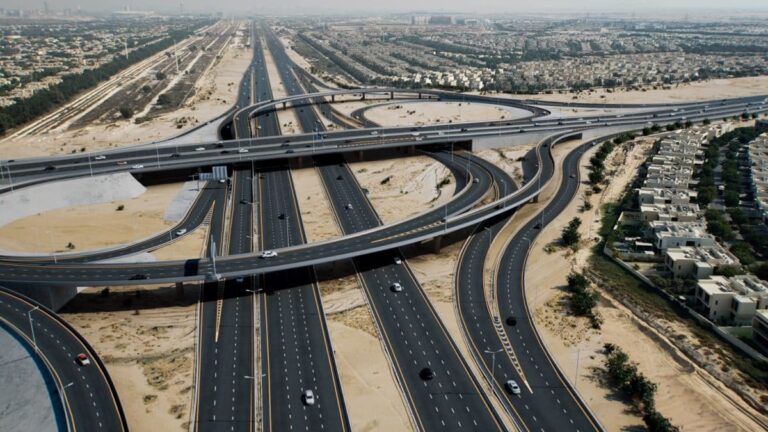
Dubai has opened three new bridges and two loop ramps at the intersection of Al Qudra Road and Sheikh Zayed bin Hamdan Al Nahyan Street, reducing journey times at the junction by 85 per cent.
The Roads and Transport Authority (RTA) announced the opening as part of the wider Al Qudra Road Major Intersections Development Project, which aims to improve traffic movement across growing residential communities and development areas in the emirate.
The newly opened bridges and ramps have a combined length of 2,660 metres. The infrastructure is designed to enable smoother traffic movement in all directions, saving motorists approximately seven minutes of waiting time compared with previous conditions.
The project serves residential and development areas with a combined population of more than 400,000 residents and visitors, strengthening connections between neighbourhoods, major highways and important destinations across Dubai.
Dubai Opens Three Bridges and Two Loop Ramps
The completed infrastructure includes three bridges and two loop ramps designed to accommodate traffic travelling towards key destinations across the emirate.
The new structures comprise:
- 750-metre bridge: A two-lane route towards Jebel Ali.
- 900-metre bridge: A two-lane route towards Dubai city centre and Dubai International Airport.
- 500-metre bridge: A single-lane route towards Al Qudra City.
- 230-metre loop ramp: A two-lane connection towards Al Qudra City.
- 280-metre loop ramp: A two-lane connection towards Umm Suqeim.
The works also include three kilometres of service roads on both sides of Sheikh Zayed bin Hamdan Al Nahyan Street.
Together, these improvements are intended to reduce congestion at the intersection, support uninterrupted traffic movement and improve access along one of Dubai’s important road corridors.
Wider Al Qudra Road Project Targets 70% Faster Journeys
The newly opened bridges form part of a broader development programme covering Al Qudra Road from its intersection with Sheikh Mohammed bin Zayed Road, through Sheikh Zayed bin Hamdan Al Nahyan Street, to Emirates Road.
The wider project includes seven bridges and four ramps across three major intersections, with a combined length of 4,750 metres. It also involves improvements and widening along 11.6 kilometres of Al Qudra Road.
According to RTA figures, the overall project is expected to deliver substantial improvements in travel times and road capacity.
Key targets include:
- 70 per cent reduction in journey times, from 10 minutes to three minutes.
- 33 per cent increase in road capacity, rising from 12,000 to 16,000 vehicles per hour in both directions.
- More than 400,000 residents and visitors served across the surrounding residential and development areas.
The 85 per cent journey-time reduction applies to the newly upgraded intersection, while the 70 per cent figure relates to the wider Al Qudra Road development project.
Residential Communities Set to Benefit
The project is expected to improve connectivity for several residential communities and development areas across Dubai, including:
- Arabian Ranches 1 and 2
- DAMAC Hills
- Dubai Motor City
- Mudon
- Dubai Studio City
- The Sustainable City
- Akoya
- Town Square
- Mira
- DAMAC Hills 2
For residents travelling between these communities and other parts of Dubai, improved junction capacity could help make daily commutes and journeys to major destinations more efficient.
The upgraded road network also strengthens connections to key transport corridors serving Dubai International Airport, Jebel Ali and other parts of the emirate.
RTA Highlights Infrastructure’s Role in Dubai’s Growth
Mattar Al Tayer, Director General and Chairman of the Board of Executive Directors at RTA, said road network development remained strategically important to Dubai’s urban and economic expansion.
He highlighted the need for advanced infrastructure capable of accommodating future growth while improving the appeal of residential, development and investment areas.
The Al Qudra Road project reflects Dubai’s continued investment in transport infrastructure as residential communities expand and traffic demand increases.
A Major Milestone for Dubai’s Road Network
The completion of the three bridges and two loop ramps marks a significant milestone in the wider development of Al Qudra Road.
With improved traffic movement, additional road capacity and stronger connections to major highways, the upgrades are designed to support commuters, residents and visitors travelling across the emirate.
As Dubai continues to expand, projects such as this are intended to ensure that road infrastructure keeps pace with urban development while making journeys between residential communities and key destinations more efficient.