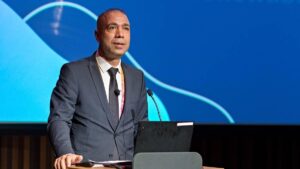
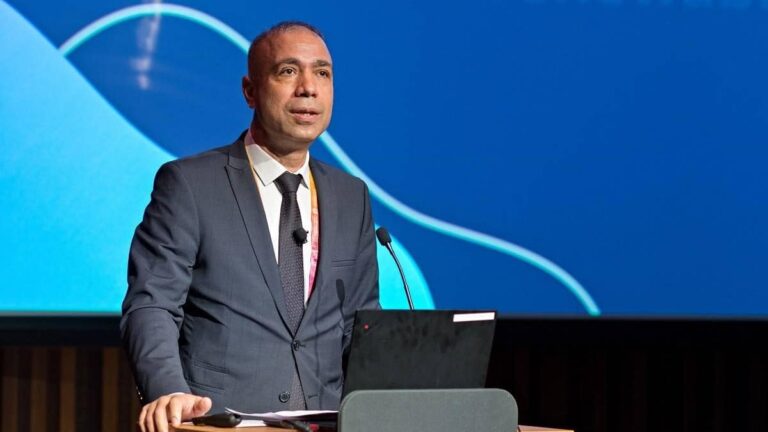
International cooperation, trust and long-term partnerships are essential to strengthening global energy security, Azerbaijan’s Deputy Minister of Energy, Dr Elnur Soltanov, said during ADIPEC 2026 in Abu Dhabi.
Speaking at a panel discussion titled “Beyond Borders: Can National Energy Strategies Deliver a Connected Global System?”, Soltanov emphasised that countries must work together to develop energy systems capable of responding to growing demand and global uncertainty.
“For us, cooperation is survival, first and foremost,” he said.
Soltanov noted that cooperation requires commitment from all parties, warning that countries cannot sustain meaningful partnerships if only one side is willing to collaborate.
“You cannot unilaterally cooperate. You have to make sure that everybody cooperates. Otherwise, you end up being a loser,” he said.
Shifting From Competition to Shared Success
Soltanov argued that international energy relationships should move beyond a narrow, competitive approach and instead focus on outcomes that benefit all participants.
He said governments and industry partners must work to transform negotiations from a “win-lose” mindset into a “win-win” framework, where cooperation creates shared value and supports long-term stability.
Trust, he added, is central to making such partnerships work.
Pointing to Azerbaijan’s experience with production-sharing agreements (PSAs), Soltanov highlighted the country’s record of maintaining the terms of its agreements with energy companies.
“We are the country who didn’t change its PSAs even once. And that sends a really, really good signal to our partners,” he said.
The agreements define the conditions under which energy companies develop oil and gas resources. Soltanov’s remarks underscored how consistent contractual arrangements can strengthen investor confidence and encourage long-term commitments.
The Interplay of Politics and Economics
The deputy minister also stressed that energy partnerships are shaped by both commercial interests and political relationships.
Referring to Azerbaijan’s longstanding partnership with British energy company BP, Soltanov recalled how the relationship was viewed when the company was invited to invest in the country during the 1990s.
“When we invited BP, which was our strategic partner, energy partner, to be honest with you, maybe I’m going above my pay level saying this, but at the same time, BP, we thought in the 1990s, it is coming with a country it’s headquartered in, right?” he said.
He added that the relationship demonstrated the importance of understanding the wider political context behind energy investment.
“So politics and economics, an interplay of both factors is very, very important, especially in our context,” Soltanov said.
His comments reflected the broader role of diplomacy in shaping energy cooperation, particularly as countries seek reliable partners and secure supplies in an increasingly interconnected global market.
Resilience Through Long-Term Partnerships
Soltanov also highlighted resilience as a priority, drawing on Azerbaijan’s experience managing relationships across the Caucasus region.
His remarks came as government officials, energy executives and investors gathered in Abu Dhabi for the ADIPEC 2026 strategic conference, where discussions focused on how international cooperation can support rising energy demand, economic growth and stronger global energy systems.
As countries navigate shifting energy needs and geopolitical pressures, Soltanov’s message was clear: lasting energy security depends not simply on competition for resources, but on trust, dependable agreements and partnerships built to endure.