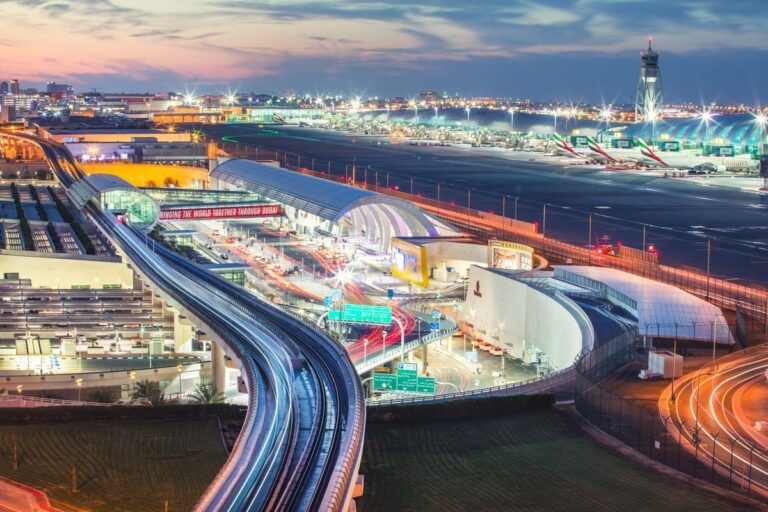
Dubai once again sits firmly at the center of global air travel. Dubai International Airport (DXB) has retained its position as the world’s busiest airport in February, after airlines scheduled nearly 4.9 million international seats during the month, according to new data released by OAG, the global aviation analytics firm.
That figure—equivalent to approximately 9.8 million seats in both directions—secured Dubai’s top ranking worldwide, with international seat capacity rising 2% year on year compared to February 2025. The performance highlights DXB’s sustained dominance in international aviation, even as global markets adjust to shifting travel demand.
A Run of Record-Breaking Performance
OAG noted that Dubai International’s February results extend a strong run of record-setting months. Capacity has consistently expanded since last year, underscoring the airport’s resilience and strategic importance in global connectivity.
The airport reached a summer peak in 2025 and followed it with another milestone in December 2025, when passenger numbers hit their highest monthly level in the airport’s 65-year history. That momentum has carried into 2026, reinforcing Dubai’s role as a critical gateway between East and West.
Strong Start to 2026
In just the first two months of 2026, airlines scheduled around 10.4 million international seats through Dubai—roughly 20.8 million seats in both directions—reflecting robust early-year demand and continued expansion by global carriers serving the emirate.
This growth builds on strong international traffic performance throughout the first nine months of 2025, during which Dubai International steadily increased capacity and passenger volumes.
Leading the World Across All Categories
When international and domestic flights are combined, Dubai International again ranked first globally in February. Atlanta’s Hartsfield-Jackson International Airport followed in second place with about 4.6 million seats, while Shanghai Pudong ranked third with 4.2 million. Tokyo Haneda placed fourth with roughly 4.18 million seats, and Guangzhou Baiyun rounded out the top five at approximately 4.16 million seats.
Dubai also dominated in international-only capacity, far ahead of other major hubs. London Heathrow ranked second with about 3.6 million international seats, followed by Seoul with 3.5 million, Singapore with 3.4 million, and Hong Kong with 3.2 million.
Passenger Numbers Match Capacity Growth
The capacity figures mirror DXB’s strong passenger performance. During the third quarter of 2025, the airport handled 24.2 million passengers between July and September, marking a 1.9% increase compared to the same period in 2024. This pushed total passenger traffic for the first nine months of the year to 70.1 million, up 2.1% year on year.
December 2025 proved especially significant, with 8.8 million passengers passing through the airport—surpassing the previous monthly record of 8.3 million set a year earlier.
On Track to Extend a Historic Streak
Preliminary indicators suggest Dubai International is on course to retain its title as the world’s largest airport for international passengers in 2025, a distinction it has held for 12 consecutive years. Dubai Airports is expected to release full passenger figures for last year in the coming days, which could further cement DXB’s standing at the pinnacle of global aviation.
As airlines continue to expand services and demand remains strong, Dubai International’s latest performance signals not just recovery, but enduring leadership in the global aviation landscape.