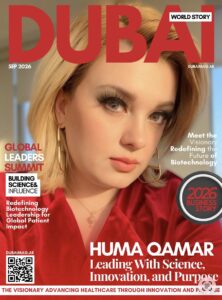
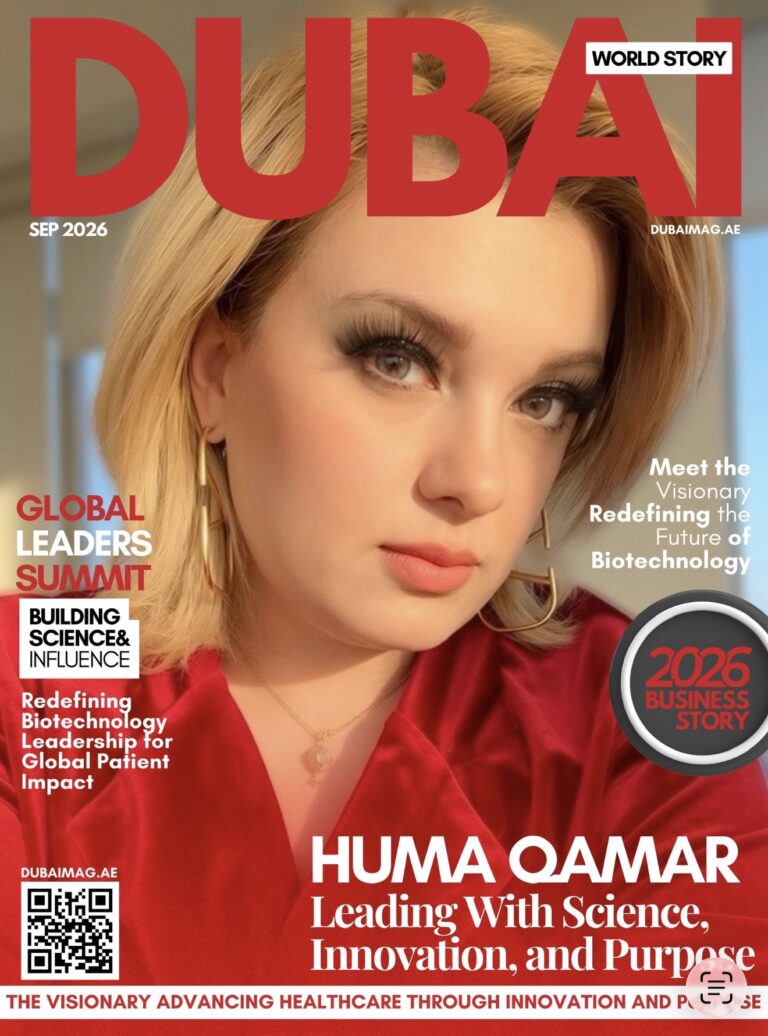
For Huma Qamar, leadership began long before she entered an executive office.
Growing up as the eldest child in a single-parent household in Pakistan, responsibility was not something she could postpone until she felt ready. She was expected to care for her younger siblings, excel academically and set an example for those following behind her.
Living in a conservative environment where certain ambitions were not always encouraged for girls taught her to challenge expectations, seek out allies and work persistently to earn her place.
“I learned early that responsibility wasn’t optional—it was expected,” Qamar says. “I don’t wait for permission or perfect conditions. I take calculated risks, set clear goals and act on them.”
Those formative experiences would eventually influence a career spanning medicine, public health, clinical research and biotechnology leadership in the United States. Today, as CEO and Co-Founder of Alma Global Consultants, Qamar draws on that multidisciplinary background to help healthcare and life-sciences organizations translate scientific potential into strategies capable of reaching patients.
Leading When the Outcome Is Uncertain
Drug development is defined by uncertainty. Clinical trials may produce unexpected results, regulatory requirements can evolve and companies must make consequential decisions while facing pressure from patients, investors and shareholders.
For Qamar, navigating these conditions requires more than technical knowledge. It demands composure, emotional intelligence and the ability to keep people focused on the next constructive step.
The steadiness she developed during childhood became an asset when leading clinical trial teams, working with the United States Food and Drug Administration on future medical strategies and operating within the strict timelines of corporate America.
“I know what it is like to carry weight before you feel ready,” she says. “That is why I try to lead with empathy while keeping people calm, focused and moving forward.”
Her leadership perspective was also shaped by progressing through frontline, operational and executive positions rather than entering the industry exclusively at a strategic level.
Early clinical experience showed her what it means for a patient and family to wait for a diagnosis or treatment decision. Later roles in clinical research and trial management revealed how one protocol delay can affect an entire programme, and how strongly successful execution depends upon trust between sponsors, research sites and their teams.
By the time Qamar reached the C-suite and served as a Chief Medical Officer, she understood that milestones and data readouts represented far more than entries on a corporate presentation.
“You never forget the patient waiting on the other side of that milestone, or the team working under pressure to reach it,” she explains. “That understanding has to be earned by staying close to the work.”
Innovation Measured by Patient Impact
Throughout her career, Qamar has worked across vaccines, oncology, rare diseases, ophthalmology, and cell and gene therapy. Two areas in particular transformed her understanding of meaningful healthcare innovation.
Her experience with CAR-T cell therapy in oncology demonstrated the possibility of moving beyond managing symptoms to reprogramming a patient’s own immune system to fight disease. It changed her perception of innovation from simply introducing a new medicine to fundamentally reconsidering how a previously formidable disease could be treated.
Her work involving modifier gene therapy for inherited retinal diseases offered another powerful lesson. Conditions such as retinitis pigmentosa, Stargardt disease and Leber congenital amaurosis can cause progressive vision loss and have historically left many patients with few or no treatment options.
The potential of a gene-agnostic approach—one that could address multiple genetic mutations instead of requiring an entirely separate therapy for each mutation—represented the type of innovation that matters most to Qamar.
“Meaningful healthcare innovation isn’t measured by scientific novelty alone,” she says. “It is measured by how many patients who were previously out of options now have hope.”
That patient-centred philosophy continues to guide her work as a strategic adviser, including her contribution as a fractional Chief Medical Officer. Working across multiple programmes has strengthened her belief that innovation frequently emerges through collaboration between organizations, disciplines and markets.
Why Alma Global Consultants Was Created
The inspiration for Alma Global Consultants came from a recurring problem Qamar observed throughout her work in biotechnology, pharmaceutical organizations, clinical research and leading academic medical centres.
She encountered highly capable scientific teams pursuing promising ideas without an equally developed business, clinical or regulatory strategy. In some cases, potentially valuable therapies stalled—not necessarily because the science was inadequate, but because the route from research to patients had not been planned clearly enough.
Qamar co-founded Alma to help close that gap.
The consultancy operates at the intersection of healthcare, biotechnology, artificial intelligence and business strategy. Its mission is to help organizations convert scientific ambition into executable plans while protecting the rigor, integrity and patient focus upon which responsible healthcare innovation depends.
This can include developing clinical and regulatory strategies, helping organizations avoid expensive strategic missteps and advising leadership teams as they make complex decisions about emerging treatments and technologies.
The underlying question is straightforward: How can a strong scientific idea become a responsible, realistic and scalable solution for the people who need it?
Combining Artificial Intelligence With Human Judgment
Artificial intelligence is rapidly changing drug development. Qamar sees genuine potential in accelerating early-stage discovery, identifying patient populations most likely to respond to a treatment, improving clinical trial design and site selection, and analyzing large volumes of clinical or genomic information.
Its possibilities may be especially significant in rare-disease research, where patient populations are limited and every available data point carries considerable value. AI can help researchers recognize patterns that might otherwise take human teams much longer to uncover.
For patients living with serious or progressive conditions, that acceleration could matter enormously.
Yet Qamar is equally clear about the limits of technology.
AI should support—not replace—human judgment when interpreting nuanced clinical findings, evaluating patient safety or understanding the personal circumstances surrounding a diagnosis. An algorithm may recognize a pattern, but it cannot assume the full responsibility of an experienced medical professional making a high-stakes decision.
“Scientific integrity depends on people who can ask, ‘Does this actually make sense?’ and not only, ‘Does the model say so?’” she says. “Patients are not data points. They are people who deserve a clinician’s judgment, especially when the stakes are high.”
Her position reflects a wider principle behind Alma’s work: speed is valuable only when paired with accountability.
Building Bridges With Dubai and the Middle East
Qamar sees Dubai and the wider UAE as natural partners for Alma Global Consultants.
The region’s focus on healthcare, life sciences, technological development and AI-driven innovation creates opportunities to introduce novel therapeutic programmes, establish international research partnerships and support companies seeking to enter Middle Eastern markets.
Alma could contribute by advising on clinical trial design, regulatory planning and the adaptation of biotechnology innovations to regional healthcare requirements. Fields such as precision medicine, rare-disease treatments and next-generation vaccines may offer particularly compelling opportunities.
Dubai’s location and international outlook also strengthen its potential to connect researchers, businesses, investors and healthcare providers from East and West.
“What excites me most is the opportunity for knowledge-sharing between U.S. clinical research expertise and the region’s investment in cutting-edge infrastructure,” Qamar says.
She believes Alma can serve as a bridge between international biotechnology innovation and the Middle East’s growing healthcare ambitions—helping to establish trials and partnerships that could bring new treatments to patients in the region sooner.
Making Space for the Next Leader
Qamar’s progress through scientific and corporate environments has not been without barriers.
As an immigrant woman, she has often found herself as the only woman or immigrant in the room. She recalls having to work harder to establish her expertise and being underestimated because of her accent, background or because she did not resemble the conventional image of a corporate leader.
Rather than allowing those experiences to define her limits, she used them to strengthen her resolve, advocate for herself and become more intentional about helping others advance.
She now mentors younger women, immigrants and foreign medical graduates entering biotechnology and clinical research. She seeks to give emerging professionals meaningful responsibility, visibility and the opportunity to develop judgment through experience.
“Representation isn’t just about being present,” she says. “It is about actively making space for the next person who does not yet see someone who looks like them at the top.”
Her approach to leadership begins with identifying the distinct strengths of each individual. She believes leaders must spend time understanding their people rather than merely supervising their output.
She also considers clear communication fundamental. Complex scientific ideas cannot become a shared commercial vision unless scientists, executives, investors and other stakeholders understand why the work matters. Qamar frequently acts as the bridge between these groups, translating technical concepts into plain language and continually connecting strategy to patient outcomes.
A Legacy of Rigor, Integrity and Hope
Qamar’s ambition for Alma Global Consultants extends beyond building a successful advisory business.
She wants the company to demonstrate that thoughtful, patient-centred strategy can move biotechnology forward more efficiently than traditional fragmented approaches. She hopes Alma will become a trusted partner to organizations attempting to transform promising science into deliverable patient impact.
For the companies she advises, success means greater clarity, stronger strategic confidence and the ability to make better decisions sooner. For patients, it means increasing the likelihood that valuable treatments move beyond the laboratory and reach the communities for which they were intended.
On a personal level, Qamar’s definition of success is not centred on titles.
It is found in therapies reaching patients faster, organizations making more responsible decisions and talented people gaining access to opportunities that once appeared closed to them.
“I want to look back and know that I used my expertise and my voice to open doors for others,” she says.
It is a mission connecting every stage of her journey—from the young girl in Pakistan who learned to lead before she felt ready to the biotechnology executive helping organizations navigate some of healthcare’s most complex questions.
Through Alma Global Consultants, Qamar is working toward a future in which scientific ambition is supported by strategic clarity, artificial intelligence remains anchored in human responsibility and innovation is ultimately judged by the hope it creates for patients.